
B
ben
Greater Indianapolis
"Best quality products on the market and the installers were easy to communicate with. Would highly recommend."
Google Review
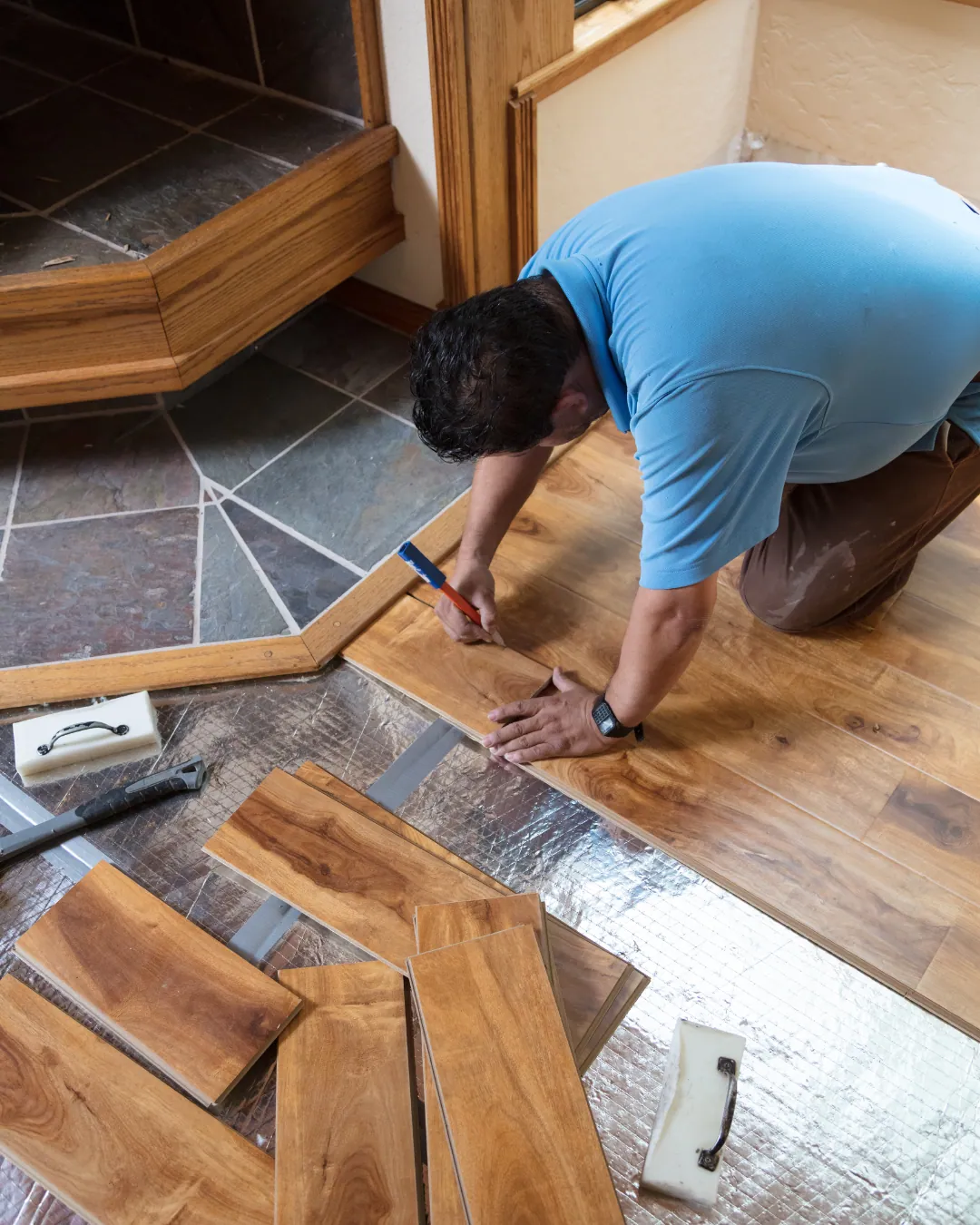
Searching "flooring installers near me" returns a lot of companies that look identical. Here is what actually separates them.
Search "flooring installers near me" and you get a page of companies that all promise quality work and free estimates. The differences that matter are not on the website - they are in who does the work, what the quote covers, and what happens if something goes wrong. Here is what to check.
This is the single most useful question, and a lot of homeowners never ask it. How much experience do the installers have with the floor you are buying? Hardwood, LVP and carpet are different trades, and a floor installed by someone who does that material every week looks different from one installed by someone who does it twice a year.
The second half of the question is who owns the outcome. When a transition is cut wrong or a seam lands in the wrong place, you want one company that answers the phone and puts it right, not a chain of people pointing at each other.
Every TFPros floor is installed by hand-selected, experienced specialists, and we put our own labor warranty on the work rather than just passing along the manufacturer warranty on the material.
A price per square foot is not a quote. The number that matters is the finished, installed price including everything that has to happen before the new floor goes down.
A complete quote should account for tear-out of the existing floor, disposal, subfloor prep, moving furniture, transitions and trim, and the material itself. Any of those left off is a line item that reappears later. If two quotes are far apart, the difference is almost always in what one of them left out - not in the material.
Ask specifically about subfloor prep, because it is the item most often excluded. Nobody knows exactly what is under the old floor until it comes up, but a good estimator will tell you what they expect to find and how it would be handled.
Any company willing to quote your whole house over the phone is guessing. Square footage is only part of the price - the layout, the number of rooms and transitions, stairs, the condition of the subfloor and how much tear-out is involved all move the number substantially.
An in-home measure also lets you see material in your own light. Flooring looks meaningfully different under showroom lighting than it does in your living room at 4pm in January, and choosing a color from a small sample in the wrong light is one of the more common regrets.
There are always two, and they cover different failures. The manufacturer warranty covers the material - delamination, finish failure, defects in the product itself. The labor warranty covers the installation - seams, transitions, stretch, everything the crew did.
Material rarely fails. Installation is where problems actually come from, which makes the labor warranty the one worth reading. If a company only mentions the manufacturer warranty, ask directly what happens if the installation itself has a problem in six months.
A company that already works your area regularly can get to a measure appointment sooner and is not building travel time into the price. It also means they have seen the housing stock before - the slab-on-grade builds around Fishers and Westfield, the layered subfloors in older Carmel and Noblesville neighborhoods, the basements on the south side.
Central Indiana has its own conditions too. Humid summers and dry heated winters make wood move, which is why acclimation before installation is not optional here and why engineered hardwood is often the more practical choice than solid in rooms with real humidity swings.
How experienced are the installers with this floor type? Does the quote include tear-out, disposal and subfloor prep? What happens if you find a problem with the subfloor once the old floor is up? What is the labor warranty, and how long is it? When can you actually start, and how long will the job take?
Any established company will have quick answers to all five. Hesitation on the first or the fourth is the useful signal.
Factory-direct pricing across Indianapolis, Carmel, Fishers, and the surrounding metro. Quick installs of upper-end USA products - most projects wrap in 1 to 2 weeks, backed by a 1-year labor warranty plus the manufacturer's lifetime warranty - up to a 50-year hard surface lifespan.