
D
Daniel
Greater Indianapolis
"Had them out to quote the floors in my rental house. The process was quick, easy, and no gimmicks. Loved their selection and prices."
Google Review
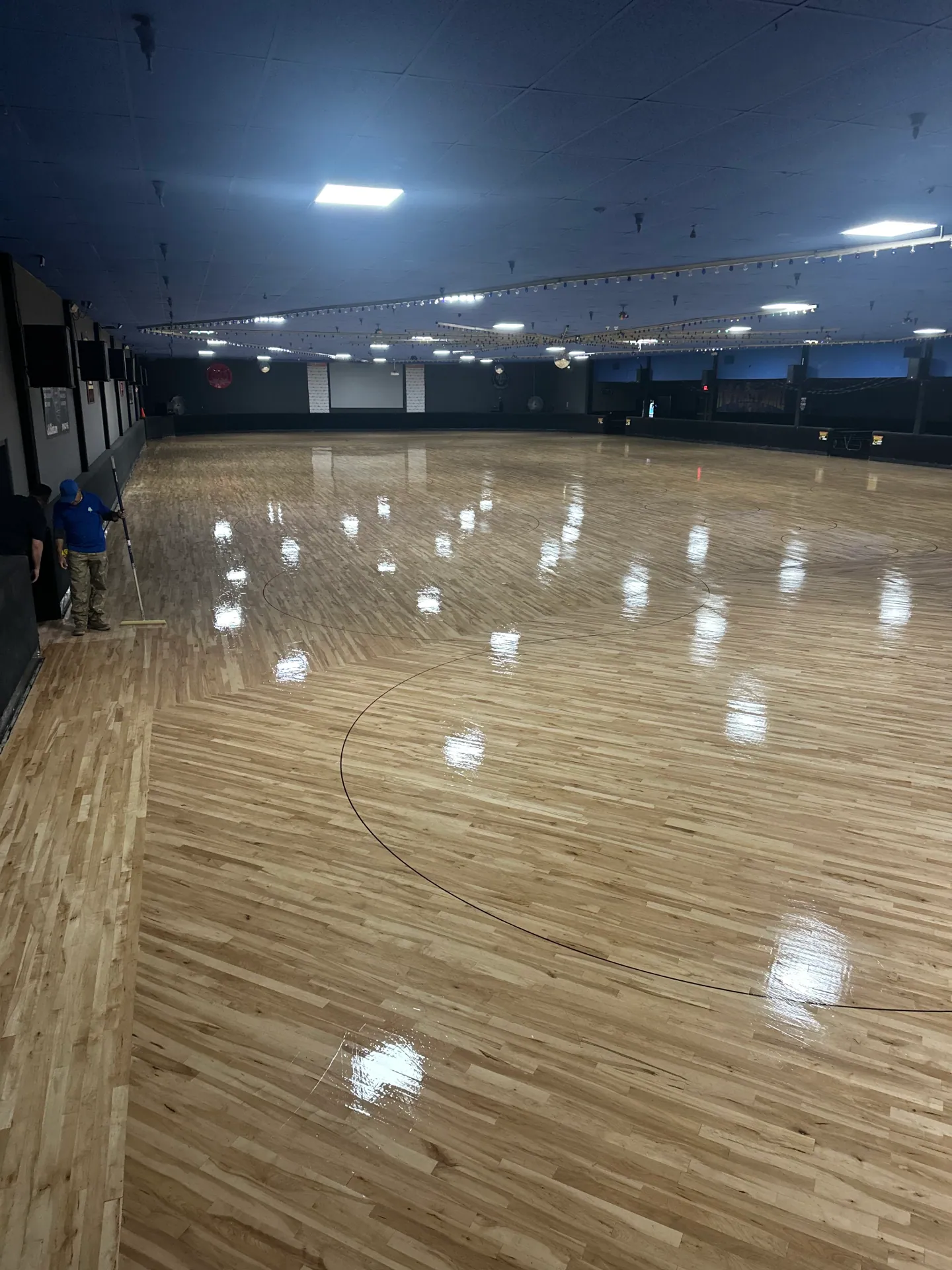
Forklifts, pallet jacks, point loads and washdowns. What separates an industrial floor spec from a commercial one, and the questions to answer before anyone quotes.
Central Indiana runs on distribution. The corridors out through Plainfield and along I-70, the light manufacturing across the southeast side, the trade shops in every county around the city - a lot of the floors we are asked about are not offices, and an office floor put into a warehouse fails quickly and expensively. Industrial flooring is a different specification driven by different forces, and getting it right starts before anyone quotes a material.
An office floor is designed for foot traffic, rolling chairs and appearance. An industrial floor is designed for loads, and loads behave very differently.
A forklift concentrates several thousand pounds onto small hard wheels. A pallet jack drags a point load across a surface with no suspension at all. Racking legs sit still and press down in the same square inch for years. Dropped tools, steel stock dragged across a bay, hot tires parked on the same spot every night, and in a lot of spaces a washdown cycle with chemicals that would strip a domestic finish.
Any one of those will destroy a floor chosen for a lobby. The question is never simply what looks industrial - it is which of those forces your building actually sees, and how often.
In almost every industrial building the concrete slab is the structural floor, and whatever goes on top is a wear surface. That makes the condition of the slab the first thing to establish rather than the last.
Three things decide what is possible. Flatness, because a resilient floor telegraphs every hump underneath it and a coating will not fix a dip. Moisture, because a slab poured on grade moves vapor upward continuously and that vapor is what lifts glue-down floors and blisters coatings - it is measurable, and it should be measured rather than assumed. And existing contamination, because old oil, curing compounds and previous coatings all affect adhesion.
Subfloor preparation covers this properly. In an industrial building it is not a preliminary step, it is most of the job.
Polished or sealed concrete is the default in open warehouse space. The slab is already there and already carrying the loads, so treating it rather than covering it removes the failure mode of something bonded on top letting go. It handles forklift traffic well and it is the lowest-maintenance option. It is hard, loud, and unforgiving of anything dropped on it - which in a warehouse is usually fine.
Resinous coatings, epoxy and urethane systems go where you need chemical resistance, washdown capability, or a marked-out safety scheme. They live or die on surface preparation and on moisture, which is why the honest version of this conversation starts with slab testing rather than color charts.
Commercial-grade vinyl - sheet or heavy-wear tile - belongs in the parts of an industrial building that are not the warehouse: production offices, break rooms, corridors, QA areas. It is quieter, warmer and easier to replace in sections. Our vinyl page covers the grades.
Broadloom or carpet tile in the office block. Carpet tile in particular is worth knowing about in an industrial setting because a damaged tile is replaced individually rather than reflooring a room.
Not in the middle of the bay. At the edges.
Dock doors, where weather, road salt and pallet traffic all arrive at once. The line between warehouse and office, which is usually a change of material and a change of height. Drain surrounds in any washdown area. Expansion and control joints in the slab, which move and will tear a rigid surface that bridges them without being detailed for it.
When a facility calls us about a floor that has failed, it is usually one of those four, and it is usually because the transition was treated as a trim detail rather than as the hardest-working part of the installation.
What runs on this floor, how heavy is it, and what are its wheels made of? Hard polyurethane forklift wheels and pneumatic tires do not do the same damage.
Is anything spilled on it, and what? Oils, solvents, food acids and hot water all rule different products in and out.
Does it get washed down, and how - mop, auto-scrubber, or hose?
How much downtime can you give it? Coatings need cure time and cure time is the constraint that most often decides the system. If the answer is close to none, that changes the plan - which is what reflooring a business that cannot close is about.
What is the slab's moisture reading? If nobody knows, that is the first thing to find out.
We handle commercial and industrial flooring across the metro - Indianapolis, the Hendricks County corridor through Plainfield, Avon and Brownsburg, and north into Carmel, Fishers, Westfield and Zionsville.
Walk the space with us and we will tell you what the slab will and will not support before anyone talks about product. Book a site visit.
Factory-direct pricing across Indianapolis, Carmel, Fishers, and the surrounding metro. Quick installs of upper-end USA products - most projects wrap in 1 to 2 weeks, backed by a 1-year labor warranty plus the manufacturer's lifetime warranty - up to a 50-year hard surface lifespan.