
D
Daniel
Greater Indianapolis
"Had them out to quote the floors in my rental house. The process was quick, easy, and no gimmicks. Loved their selection and prices."
Google Review
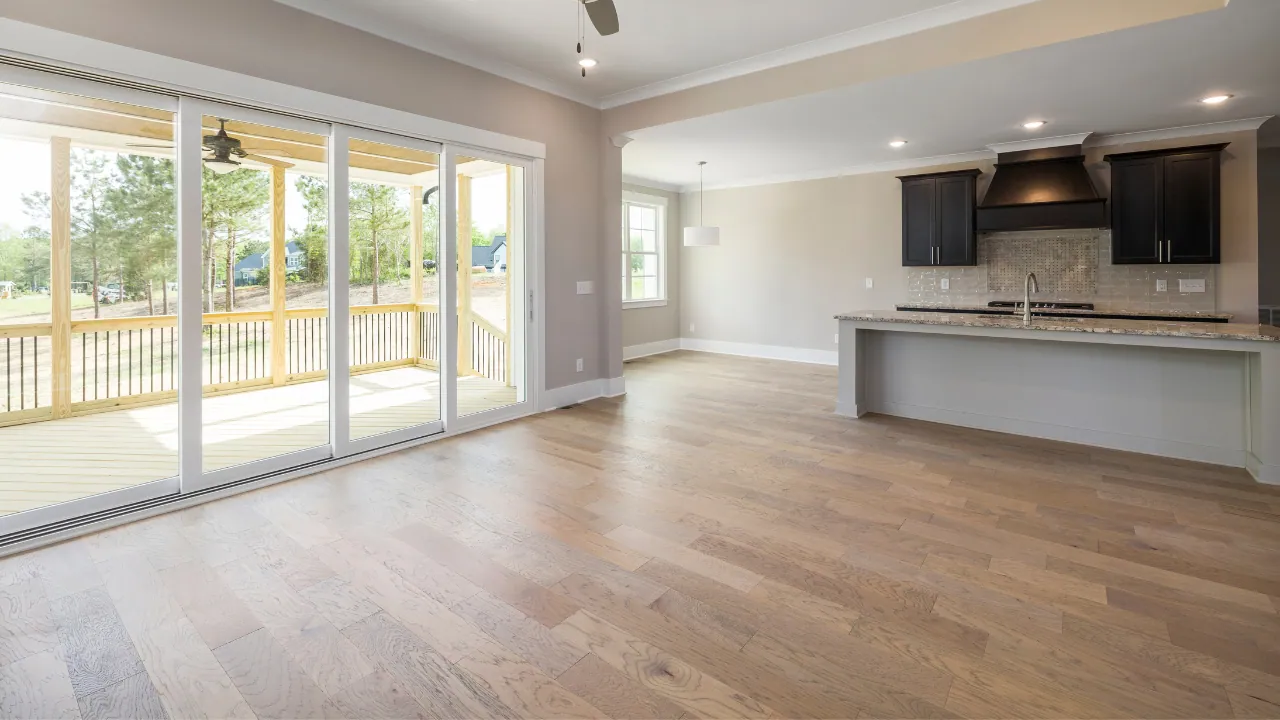
Laminate has changed. The gap between older water-resistant products and modern waterproof ones is real, and so are the limits of both.
Laminate used to have one well-known weakness: water got into the core and the plank was finished. Modern waterproof laminate is a genuinely different product, and the words on the box matter. Here is what each claim covers and where laminate still does not belong.
Water-resistant means the surface holds water out for a period of time. A spill wiped up promptly does nothing. Water left to sit will eventually get past it.
Waterproof means the core itself will not swell or break down when water reaches it. That is the meaningful upgrade, because laminate's traditional failure was always the core rather than the surface.
The distinction is worth checking on the actual product rather than assuming, because the two terms sit next to each other in marketing and describe different levels of protection.
A waterproof plank does not make a waterproof floor. Water runs along the surface, finds the seams between planks and goes underneath, and what is under there — the subfloor — is not waterproof.
So waterproof laminate means you probably do not have to replace the floor after a spill. It does not mean you can leave a slow leak unattended, because the moisture trapped beneath a floating floor has nowhere to evaporate to.
Find the leak, and find it quickly. That advice does not change with the product.
Laminate's real strength is not water at all — it is scratch resistance. The aluminium-oxide wear layer on laminate is harder than most finishes on wood and harder than many vinyl wear layers.
For a household with large dogs, that matters more day to day than waterproofing does. Laminate is a legitimately better choice than hardwood for scratch resistance, and better than many vinyls, and it is underrated for that reason.
It is also very good in living areas, bedrooms and hallways, where the demand is traffic rather than water.
Bathrooms, laundry rooms and anywhere with a floor drain. Not because waterproof laminate fails immediately, but because those rooms see repeated standing water rather than occasional spills, and there are materials better suited to that.
Basements are the other one, and the reason is the subfloor rather than the laminate. Below-grade concrete passes moisture upward, and a floating floor over an unmanaged slab traps it. Our guide to waterproof flooring for Indianapolis basements covers what belongs down there.
Laminate is a floating floor, which means it needs an expansion gap around the entire perimeter, hidden under the baseboard. Without it the floor lifts or peaks, and that is the most common laminate failure by a distance.
It also needs underlayment, which controls how the floor sounds and feels underfoot and cushions the locking joints. Some products come with it pre-attached — worth checking rather than paying twice or ending up with none.
And it needs a flat subfloor. Dips cause the locking joints to flex until they separate, which is what produces an unexplained gap in the middle of a floor.
Factory-direct pricing across Indianapolis, Carmel, Fishers, and the surrounding metro. Quick installs of upper-end USA products - most projects wrap in 1 to 2 weeks, backed by a 1-year labor warranty plus the manufacturer's lifetime warranty - up to a 50-year hard surface lifespan.