
M
Michael
Greater Indianapolis
"Way less expensive than the big companies and way better quality too. Installers were great!"
Google Review
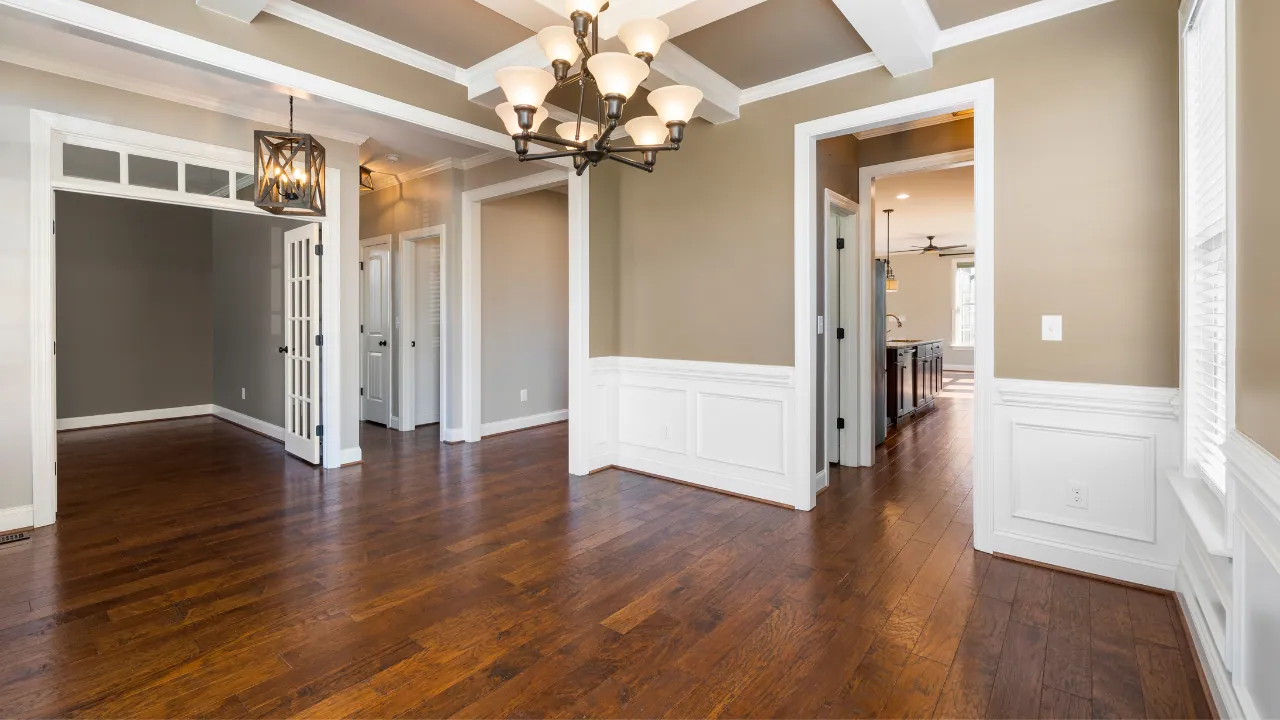
White oak, wide plank, matte finish, run the length of an open main floor. Why that is the Carmel look, and what changes between a 1990s two-story and a new build by the roundabouts.
More people search for hardwood floor installation in Carmel than in any other city we serve outside Indianapolis itself, and the houses behind those searches are not all the same house. Carmel splits into the established 1980s-to-2000s subdivisions, with their two-story layouts and plywood subfloors, and the newer construction around City Center, the Arts & Design District and the Monon, much of it over slab or radiant heat. The right hardwood is different in each. This is what goes into a Carmel house, why white oak and wide plank have taken over, and what the install involves from the first measure to the last transition.
Walk into a recently floored Carmel house and you will almost certainly see white oak, in planks five inches or wider, with a matte or low-sheen finish in a natural or lightly warmed tone. Not red oak, not the narrow 2 1/4-inch strip that went into these subdivisions when they were built, and not the high-gloss amber that dates a floor to the decade it was finished.
There are reasons beyond taste. White oak has a tighter, straighter grain than red oak and takes a light or neutral stain without the pink undertone that red oak fights you on. It is harder and more water-resistant, which matters in an open plan where the kitchen is part of the floor. Wide planks show more of that grain and fewer seams, which reads as calmer across a large open room. And matte finishes hide the dust, dog hair and micro-scratches that a gloss finish advertises.
The practical version: a wide-plank white oak floor in a low sheen is the floor that photographs well, survives a family, and still looks current in fifteen years. That is why it dominates here.
Most of Carmel's housing went up between roughly 1985 and 2010, in subdivisions west of Keystone and north of 116th, and the pattern is consistent: a two-story with a formal entry, carpet or narrow oak strip through the main floor, a plywood subfloor over a basement or crawl space, and often original hardwood in the entry and kitchen only.
These houses are the easiest hardwood install in the county. A plywood subfloor means solid 3/4-inch hardwood can be nailed down the traditional way, which gives the most solid feel underfoot and a floor that can be sanded and refinished for decades. Standard species install in about two weeks once the material has acclimated in the house.
The decision in these houses is usually scope. Owners who want the current look through the whole main floor take up the original strip along with the carpet and start fresh, because matching new wide-plank white oak to twenty-five-year-old narrow red oak is not possible and the seam between them is exactly where the eye lands. Replacing builder-grade carpet in a Carmel or Fishers home covers the carpet half of that decision.
The newer Carmel, the townhomes and custom builds around City Center, the Arts & Design District, the Monon corridor and the developments out toward Clay Terrace, is a different substrate. Many of these are slab-on-grade, many have finished lower levels, and a meaningful number have hydronic radiant heat in the floor.
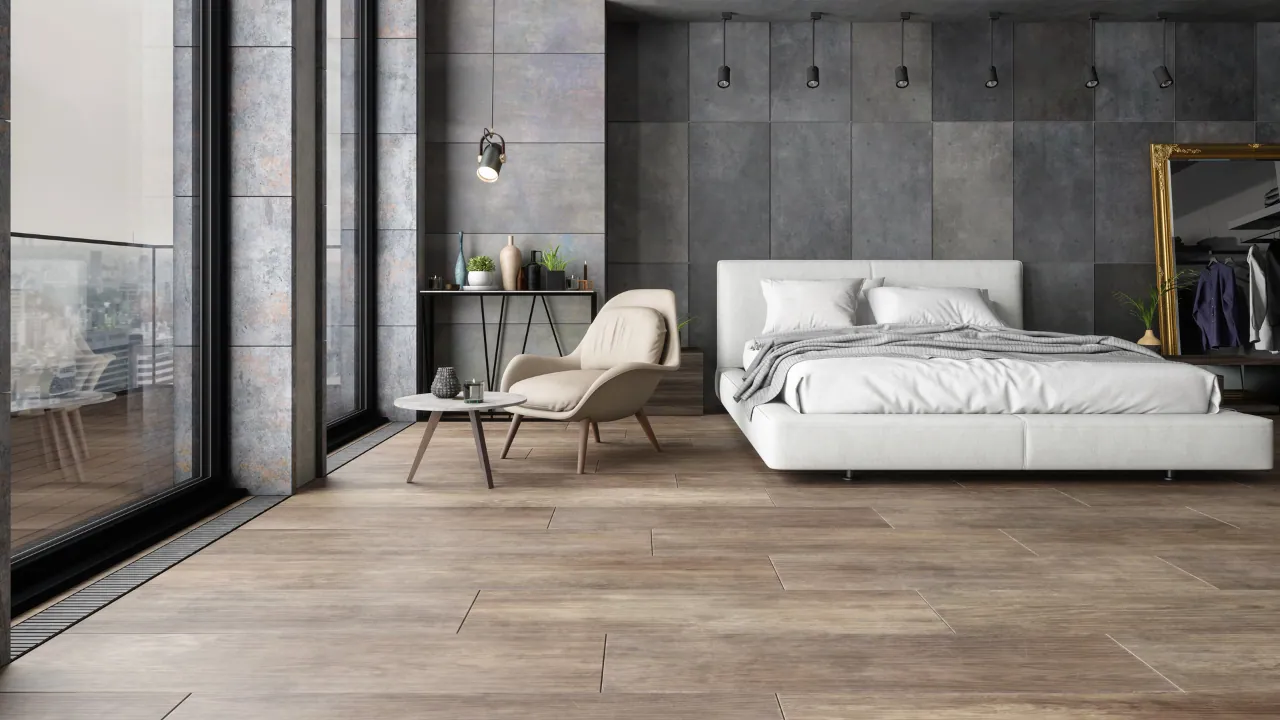
Solid hardwood does not belong over a slab or over radiant heat; it moves too much. The right product is engineered hardwood: a real sawn white oak face, 3 to 6 millimeters thick, on a stable plywood core, glued down to a tested slab or floated over a vapor barrier. Visually it is identical to solid once it is down, it comes in the same 5, 7 and 9.5-inch widths, and a thick wear layer can still be refinished. It is what most new Carmel construction should have and often does not.
The install here starts with a moisture test on the slab, documented, before anything is ordered. We laser-grade the concrete, fill low spots with self-leveler and use the adhesive matched to the readings. Skip that sequence and the floor telegraphs the slab and lifts at the seams within a couple of seasons.
White oak is the default for the reasons above, and it is what most Carmel homeowners end up choosing after seeing the samples on their own floor. It is not the only answer.
Hickory is harder still, with dramatic color variation from cream to dark brown within a single board. It suits a rustic or transitional house and hides wear extremely well, and it is polarizing; people love it or do not. Red oak is the value choice and still the right one if you are matching existing red oak in part of the house. Maple is pale and smooth and shows every scratch. Cherry darkens beautifully with light and is best kept out of sun-heavy rooms.
On width: 5-inch is the safe modern choice, 7-inch reads as a statement in a large open room, and 9.5-inch belongs in a big house with long sightlines. Wider planks move more with the seasons, which is one more reason engineered construction makes sense at the widest widths. We bring the full species and width line to the house so you can lay the exact plank against your cabinets and trim before committing.
Pre-finished planks arrive with a factory aluminum-oxide finish, cured harder than anything applied on site, and you can walk on them the day they go down. The finish choice is sheen and texture.
Matte and satin are what almost everyone chooses now, because they read as natural wood rather than as a coating and because they hide the marks a household makes. Wire-brushed texture goes further, pulling the soft grain slightly to leave a subtle relief that disguises small dents and scratches entirely. Gloss looks striking for the first month and then shows every footprint. In a Carmel house with children and a dog, matte or wire-brushed is the practical answer.
If you are sanding and finishing an existing floor rather than installing new, choosing between refinishing and replacing explains when each makes sense.
Almost every Carmel two-story has a staircase visible from the front door, and the question of whether the new hardwood continues up it changes the project more than any room does. Matching treads, risers and nosings in the same white oak make the entry read as one piece and are the single most noticeable upgrade in the house. They are also fitted one step at a time, which is why they are priced separately. Hardwood stairs and landings covers what the work involves and the carpeted-runner alternative.
It begins with a free in-home consultation. We measure, look at the subfloor, put a meter on any slab, and lay samples on your floor in your light. You get a written quote with the material, the square footage, the removal, the prep, the transitions and the stairs each as their own line. The cost factors behind a central Indiana flooring job explains what moves the number, and hardwood flooring cost in Indianapolis goes deeper on the hardwood-specific ones. Samples on your own floor is not a formality either - how to choose a floor color is why we do it that way.
The material is delivered and sits in the house to acclimate. Our own crew, the same people from the measure to the last piece of trim, removes the old floor, preps the subfloor, and installs. Furniture moving and old-floor removal are in the quote. Every job carries a one-year labor warranty from us on top of the manufacturer's lifetime warranty on the product.
We are based in Franklin Township on the southeast side and work across Carmel, Westfield, Fishers and Zionsville every week. Book a consultation here.
Factory-direct pricing across Indianapolis, Carmel, Fishers, and the surrounding metro. Quick installs of upper-end USA products - most projects wrap in 1 to 2 weeks, backed by a 1-year labor warranty plus the manufacturer's lifetime warranty - up to a 50-year hard surface lifespan.