
B
ben
Greater Indianapolis
"Best quality products on the market and the installers were easy to communicate with. Would highly recommend."
Google Review
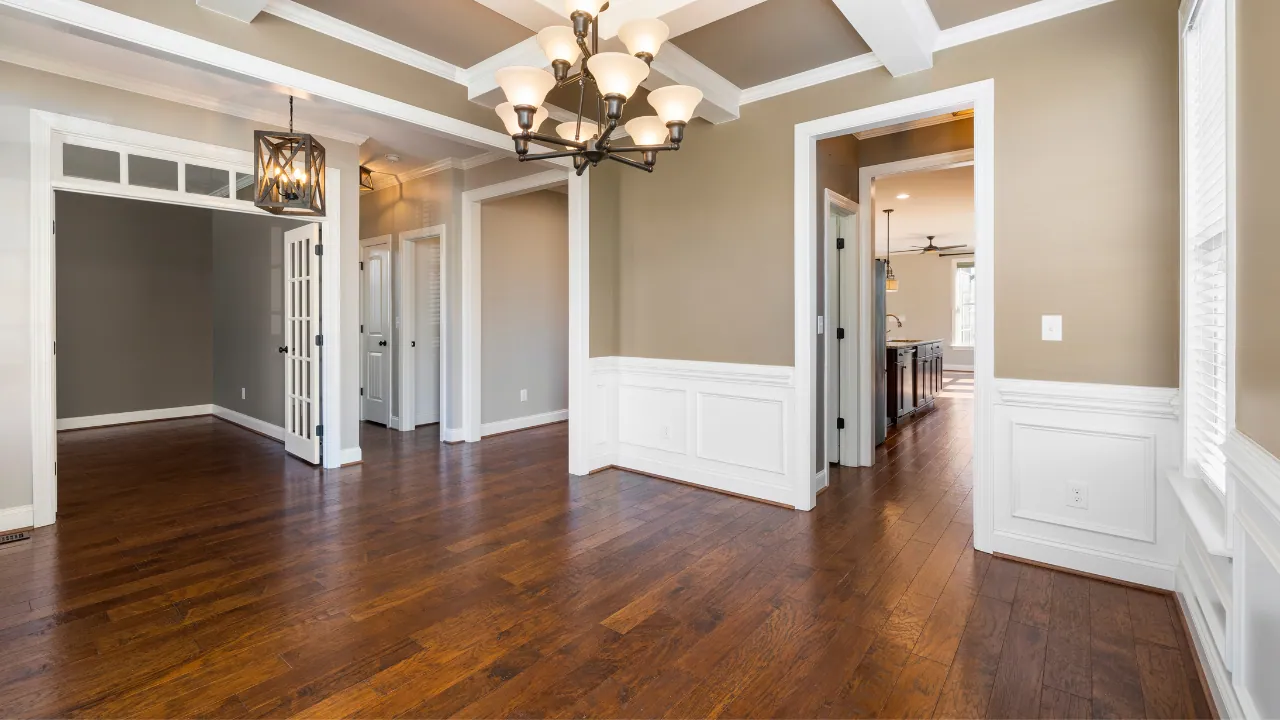
Species decides more than color. Hardness, grain, how a stain takes and how the floor ages in sunlight all change from oak to hickory to maple to cherry. Here is how they compare.
When people choose a hardwood floor they usually start with color, and color can be changed with stain. What cannot be changed is the species: how hard the wood is, how busy the grain looks, how it takes a stain and how it changes over the years. The five species we install most, white oak, red oak, hickory, maple and cherry, each behave differently in a house. Here is how they compare, and how to match one to the way your household lives.
Wood hardness is usually given as a Janka rating: the force needed to press a steel ball halfway into the wood. Higher means more resistant to dents. Commonly published figures put black cherry at roughly 950, red oak around 1,290, white oak around 1,360, hard maple around 1,450 and hickory around 1,820.
Two cautions. First, Janka measures dents, not scratches. Scratches mostly happen in the finish, and every pre-finished floor we install carries a factory aluminum-oxide finish, so the finish and its sheen matter as much as the species for everyday scuffs. Matte, satin or gloss explains why. Second, a busy grain hides a dent that a plain grain shows, so a softer wood with lots of figure can look better after years of wear than a harder wood with very little.
White oak is the most requested species we install right now. It has a fairly straight, even grain, a neutral tan to light brown color, and it takes stain well, from very pale natural finishes to deep browns. It is also more resistant to moisture than red oak because its pores are closed, which is one reason it has long been used for barrels and boats.
It suits nearly any house. It is the species behind most of the wide-plank, light, natural floors in newer Carmel and Fishers homes. Hardwood floor installation in Carmel covers how it is used there.
Red oak is the classic American floor and the one in a great many older Indianapolis houses. It has a more open, pronounced grain than white oak and a warmer, slightly pink undertone. The grain hides dents and everyday wear well, and it takes stain evenly.
The undertone is the thing to look at. Under a pale or gray stain it can read pinker than people expect, so it is best judged with a sample of the actual stain in your own light. It is often a little less expensive than white oak, which makes it a sound choice for a larger area. Hardwood under the carpet covers what you may find in an older home.
Hickory is the hardest of the five, and the most varied in color. A single board can run from cream to dark brown, and a hickory floor has lots of contrast and character marks. That variety is a strength in a busy house: dents, scratches and dust disappear into it, which is why we often suggest it for homes with large dogs and children.
It is a strong look, and it suits rustic, farmhouse and transitional houses better than very minimal ones. Lay out several boxes' worth of boards before deciding, because a small sample cannot show the range. The best flooring for pets and kids compares it with other durable choices.
Hard maple is dense, pale and fine-grained, with a smooth, clean look. It is the wood of basketball courts and bowling alleys for its hardness and smoothness. In a house it gives a bright, contemporary floor.
The same fine, tight grain makes it harder to stain evenly. Darker stains can look blotchy on maple, so it is usually best left natural or close to it. And because the grain is so plain, dents and scratches show more readily on maple than on hickory or red oak, even though it is harder than either oak.
Cherry is the softest of the five and the richest in color. It starts a light pinkish brown and darkens to a deep reddish brown with exposure to light, often noticeably within the first months. Many people choose it precisely for that warm, aged color.
Two things to plan for. It dents more easily than the others, so it suits a formal dining room, a study or a bedroom better than a busy kitchen or a mudroom. And because it darkens in light, rugs and furniture left in one place leave lighter patches when they are moved. Move rugs now and then in the first year. Floors in sunny rooms covers how different woods change in light.
For a busy household with pets and children, hickory or a red or white oak with a matte or satin finish hides the most. For a clean, light, contemporary look, white oak in a natural finish, or maple. For a classic, warm floor that can be stained almost any color, red or white oak. For a rich, formal room that will not see much grit, cherry.
Species also interacts with the product. Most of these are available as solid 3/4-inch boards and as engineered hardwood with a real wood wear layer. Engineered is the right choice over a concrete slab, in a basement or over radiant heat, whatever the species. Engineered hardwood explains why.
The best way to decide is to see the woods side by side, in your rooms and your light. At a free in-home consultation we bring the full species and color line to your house so you can hold the actual planks against your cabinets and trim. We serve Indianapolis, Carmel, Zionsville and the surrounding counties. Book a time to see them.
Factory-direct pricing across Indianapolis, Carmel, Fishers, and the surrounding metro. Quick installs of upper-end USA products - most projects wrap in 1 to 2 weeks, backed by a 1-year labor warranty plus the manufacturer's lifetime warranty - up to a 50-year hard surface lifespan.