"I recently had these guys out to replace some old carpet. Was surprised by the friendliness of the employees as well as the quality of the service. Great crew that does a great job!"
Hardwood Under the Carpet: How to Check, and What to Do With What You Find
A floor you were about to pay to cover may be the best floor you could have. Which houses tend to have one, how to look without wrecking anything, and when it is honestly not worth saving.
Pull up old carpet in the right house and there is a solid oak floor underneath that has not seen daylight in forty years. It is one of the few genuinely good surprises in renovation, and it changes the whole plan: a floor you were about to pay to cover may be the best floor you could have. But not every house has one, and not every one that turns up is worth saving. Here is how to check without damaging anything, how to read what you find, and how to decide what to do with it.
Which houses have it, and which almost never do
Before wall-to-wall carpet became the norm, a hardwood floor was simply how a house was built. Oak strip flooring, and sometimes maple or pine, was nailed down as the finished floor. When carpet came into fashion it was laid straight over the top, and the wood underneath stayed put.
So the odds depend on the age of the house. Pre-war homes and the ranches and Cape Cods of the 1950s and 1960s are the good candidates. Around Indianapolis that means the older neighborhoods inside the city and the historic cores of towns like Lawrence, Franklin, Greenfield and Noblesville.
Houses built from roughly the late 1970s onward were generally designed for carpet from the start, with carpet laid directly over a plywood or OSB subfloor. In the newer subdivisions of Fishers, Westfield, Avon or Brownsburg there is almost certainly nothing under the carpet but subfloor.
Even in the right era, hardwood often does not run everywhere. Kitchens and baths usually had their own flooring, and an addition or a converted garage will have been built differently from the original house.
How to check without wrecking anything
Start with a floor vent. Lift the register out of a heating vent and look at the cut edge of the floor around the opening. You can usually see the layers in cross-section: carpet, pad, and then either the edge of solid boards or the layered edge of a plywood sheet.
Next, a closet corner. Carpet is held at the walls by a gripper strip rather than glue, and in a closet corner you can take hold of it with pliers, lift it off the strip for a look, and press it back down afterwards. Mind the gripper - it is a strip of wood full of sharp pins.
Check more than one room. It is common to find hardwood in the living room, hall and bedrooms and nothing at all in the family room that was added later.
What you are hoping to see is individual boards a couple of inches wide, running in one direction, with a finish on them. What you may see instead is a plain sheet of plywood with paint overspray and a grid of nails or staples. That is subfloor, and the question is answered.
Reading what you find
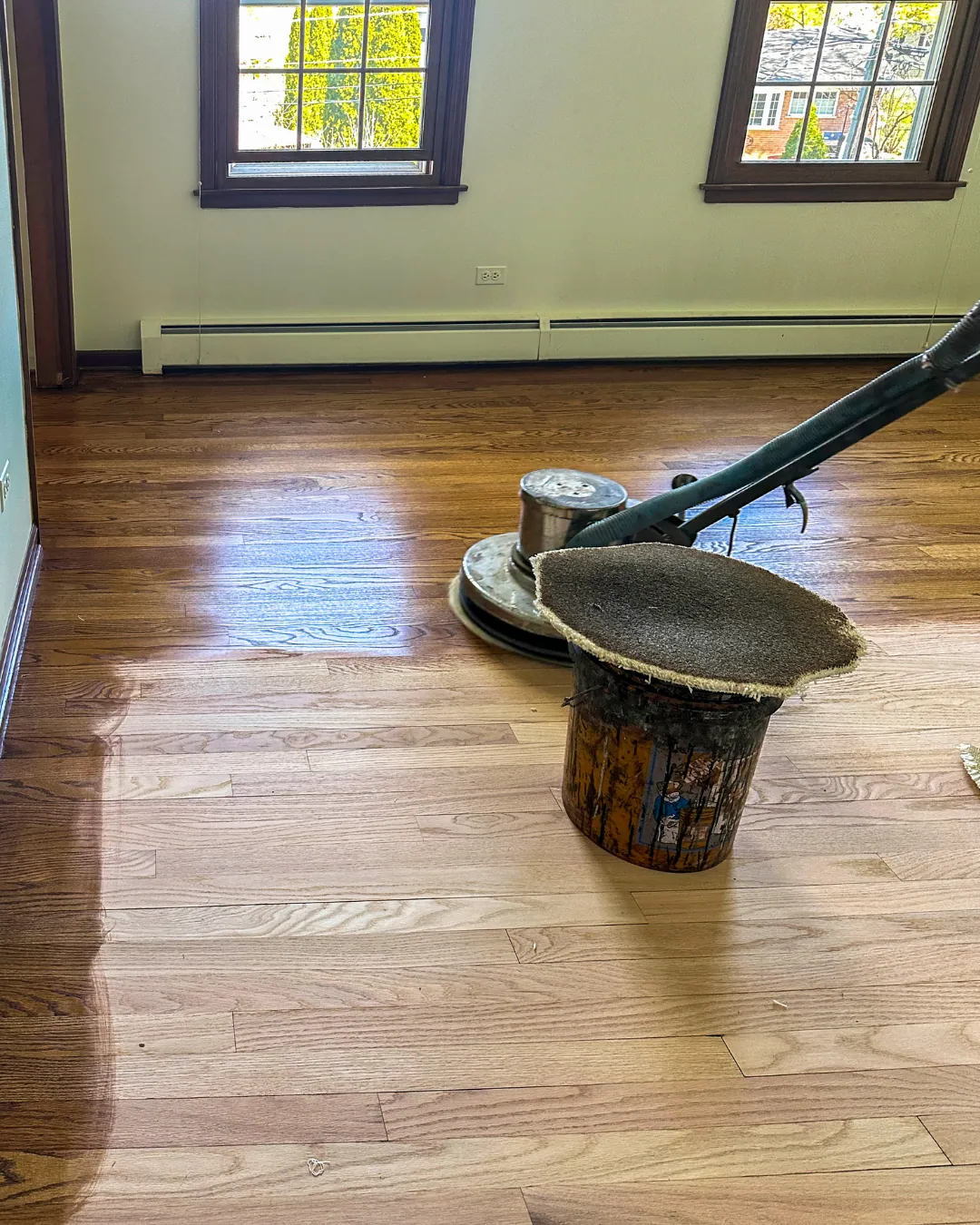
Expect it to look bad. A floor that has been under carpet for decades is dull, dusty, dotted with staples from the pad and ringed with a line of nail holes from the gripper strip. None of that matters. Staples pull, gripper holes fill, and the old finish is coming off in the sanding anyway.
What does matter is damage to the wood itself. Dark grey or black stains, usually from pets or from a plant pot that leaked for years, go deep into the board and generally do not sand out. Boards that are cupped, soft or crumbling have been wet. Wide gaps and loose, moving boards mean the floor has had a hard life. A few bad boards can be cut out and replaced. A floor that is stained or damaged across whole rooms is a different conversation.
Look for patches. Older houses often had a floor furnace grate, a wall that was later removed, or a doorway that moved, and the hole was filled with plywood because carpet was going over it. Those areas can be laced in with new boards to match, which is fiddly hand work but entirely normal.
And look at how much wood is left. At the vent opening you can see the board edge, and the wear surface above the tongue is what a sander has to work with. If nail heads are showing across the face of the floor, or the tongues are exposed at the joints, the floor has already been sanded as many times as it can be.

One caution before anyone scrapes or sands
In older houses the layer between the carpet and the wood is not always just pad. Sometimes there is old sheet flooring or tile, or the black adhesive that once held it down. Some resilient tiles and adhesives made before the 1980s contained asbestos. Left alone and intact they are not the hazard; sanding or scraping them is, because that is how fibers get into the air.
If you find old tile or black adhesive, particularly small nine-inch tiles, stop and have a sample tested by a lab before anything is disturbed. Testing is not expensive, and the result decides how the rest of the job has to be handled. It is one of the reasons we look under the existing floor before quoting rather than after.
When the floor is worth saving
If the boards are sound, there is wood left to sand, and the damage is limited to a few boards, keeping the floor is usually the right call. Refinishing a sound original floor generally costs less than installing a new one, and the oak in many of these houses is denser and more stable than most of what is milled today.
It also suits the house. An original strip oak floor in a 1950s ranch or a pre-war foursquare looks like it belongs there, because it does.
Refinish or replace your hardwood goes through that decision in more detail, including how many times a floor can be sanded.
When covering or replacing it is the honest answer
Sometimes it is not worth it. Pet damage across most of a room. A floor already sanded down to its nails. Hardwood in only half the main level when what you want is one continuous floor. A kitchen or an entry where you need a waterproof surface regardless.
There are three ways forward. Where only part of the level has hardwood, new hardwood can be woven into the old and the whole thing finished together so that it reads as one floor. Where the old floor is past saving, it can come out and new flooring can go down on the subfloor. Or, if the old boards are flat and solid, a new floor can go over the top of them.
That last option is quick and it is sometimes the right one, but it raises the finished height, and that touches doors, stair risers and appliance openings. It should be a decision rather than a default. Where two floors meet covers what a height change sets off.
Stairs are their own question. Carpeted stairs in an older house often have hardwood treads under them too, and hardwood stairs and landings covers how that fork in the road works.
Have someone look before you commit to a plan
Whether a floor is a keeper is rarely obvious from one closet corner. It takes looking at several rooms, reading the board edge, checking for moisture and finding out what, if anything, sits between the carpet and the wood.
We look under a corner of the existing carpet as part of the free in-home consultation, and we will tell you plainly if the better answer is to keep what you already own. Sometimes the best floor we can recommend is the one that is already there.
If you are in Indianapolis or the surrounding counties and you think there might be something under the carpet, book a consultation before you order anything.
Frequently asked questions
- How can I tell if there is hardwood under my carpet without pulling it up?
- Lift a floor vent register out and look at the cut edge of the floor around the opening - you can usually see whether solid boards or a plywood sheet sits under the pad. A closet corner is the second place to look: the carpet lifts off its gripper strip with pliers and presses back down. Check several rooms, because hardwood often stops at kitchens, baths and additions.
- Will the nail holes from the carpet tack strip show after refinishing?
- The gripper strip leaves a row of small nail holes a little way out from the wall around the room. They are filled during refinishing and end up as small dots near the baseboard that most people stop noticing quickly. They are not a reason to write off a floor.
- Can pet stains be sanded out of a hardwood floor?
- Light surface marks usually can. Dark grey or black stains generally cannot, because they have soaked deep into the board rather than sitting in the finish. The normal fix is to cut out and replace the affected boards and refinish the floor as a whole. If the staining covers most of a room, replacement or covering the floor becomes the more sensible answer.
- Is it cheaper to refinish the hardwood under my carpet or install a new floor?
- Where the old floor is structurally sound and has enough wood left to sand, refinishing generally costs less than installing new flooring, and the result is a real hardwood floor. The cost shifts when many boards need replacing or the floor only covers part of the level. It needs looking at in person, which we do as part of a free in-home consultation.
Explore the pages in this guide
Book a free in-home design consultation.
Factory-direct pricing across Indianapolis, Carmel, Fishers, and the surrounding metro. Quick installs of upper-end USA products - most projects wrap in 1 to 2 weeks, backed by a 1-year labor warranty plus the manufacturer's lifetime warranty - up to a 50-year hard surface lifespan.